October 2026 marks another significant point in the evolution of building regulation and building safety in England.
For developers, contractors, consultants and SMEs, the message is clear: regulatory compliance needs to be considered at the start of a project — not treated as a final-stage exercise.
Here are some of the key changes and deadlines to be aware of:
🏗️ Approved Document B — Fire Safety
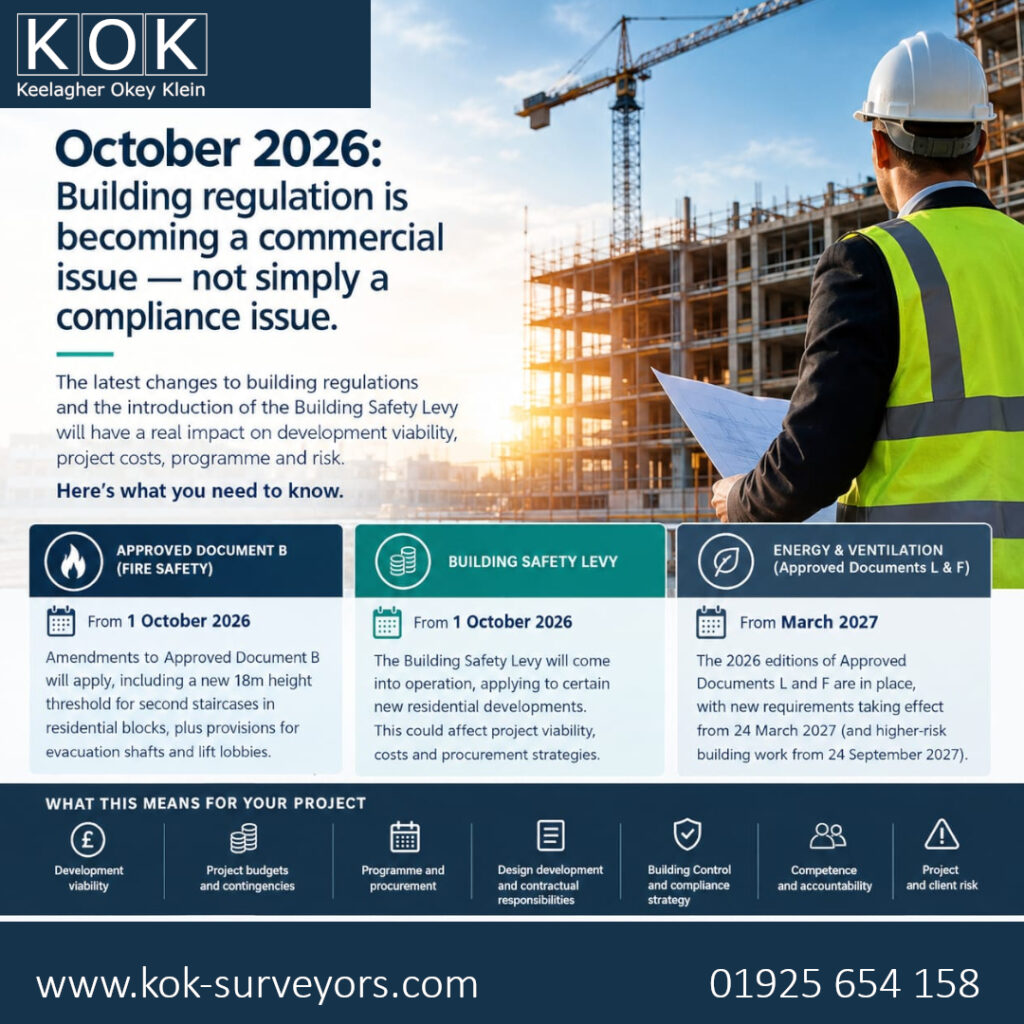
The amendments to Approved Document B take effect from 30 September 2026, meaning that from 1 October 2026, new applications will generally need to reflect the updated guidance.
One of the most significant changes is the introduction of a new height threshold for second staircases in blocks of flats where a storey is 18m or more above ground level.
The amendments also introduce provisions around evacuation shafts and evacuation lift lobbies.
For design teams, developers and contractors, this needs to be considered early — particularly where schemes are close to the 18m threshold.
Fire safety: Approved Document B – GOV.UK
💷 Building Safety Levy
The Building Safety Levy comes into operation on 1 October 2026.
The levy will apply to certain new residential development and is likely to become another important consideration when assessing project viability, development costs and procurement strategies.
Developers should understand whether their schemes fall within scope and consider the levy during financial appraisal and project planning.
Building Safety Levy: Guidance – Guidance – GOV.UK
⚡ Energy & ventilation — the next major step is already coming
The Government has also published the 2026 editions of Approved Documents L and F, supporting the Future Homes and Buildings Standards.
These changes do not generally take effect in October 2026. The new provisions are scheduled to apply from 24 March 2027, with certain higher-risk building work following from 24 September 2027, subject to transitional arrangements.
That means businesses should be preparing now rather than waiting for the implementation date.
What should SMEs be doing now?
✔️ Review projects currently in design and procurement.
✔️ Check whether schemes fall within the transitional arrangements.
✔️ Reassess fire-safety strategies where buildings are approaching the 18m threshold.
✔️ Understand potential Building Safety Levy exposure.
✔️ Review specifications, drawings and design responsibilities.
✔️ Make sure competence, information management and compliance responsibilities are clearly allocated.
✔️ Engage Building Control and specialist advisers early where the project warrants it.
The bigger picture
The construction industry is moving towards a regulatory environment where competence, accountability, evidence and compliance are becoming increasingly embedded throughout the project lifecycle.
For SMEs in particular, keeping on top of these changes isn’t simply about avoiding enforcement.
It’s about protecting programme, cost, quality and ultimately the client’s ability to deliver the project successfully.
At KOK, we believe regulatory compliance should be built into project strategy from day one — not bolted on at the end.
October is approaching. Is your business ready?